Postcards from Antarctica: tracking emissions in Port Lockroy, home to the world's southernmost post office
Off the western coast of the Antarctic Peninsula, diminutive Goudier Island sits in the shadow of the much larger Anvers Island amidst the Palmer Archipelago. Goudier is home to a colony of nearly 1,500 gentoo penguins, the third-largest penguin species after emperor and king penguins. The unassuming site is also home to Port Lockroy, a historic British outpost that boasts the southernmost post office in the world, nicknamed the "Penguin Post Office."
Port Lockroy got its unofficial start in the early 20th century, where it provided safe anchorage for whaling fleets during the Southern Ocean's industrial whaling peak. Then in 1944, it became Britain's first permanent base on the Antarctic continent, as part of a secret World War II mission to assert territorial claims. This initial wartime mission soon transitioned to a more scientific focus at Lockroy. The locale and its modest structures were eventually recognized for their historical importance and designated as a Historic Site and Monument under the Antarctic Treaty in 1994. Since 2006, the UK Antarctic Heritage Trust (UKAHT) has managed the site.
Today, tourism is Lockroy's biggest draw. People come and go by boat to see the penguins, visit the museum, buy a commemorative souvenir, and mail a postcard or two --- around 70,000 cards are sent from the site annually, mailed to over 100 countries around the globe.
A seasonal cadence at the edge of the world
The rhythm of the austral summer vs. winter defines an annual cycle of activity at Port Lockroy. During Antarctica's brief summer --- usually lasting November through March --- an influx of daily tourists swells activity on the island. A small temporary crew caretakes the facilities, staffs the post office, runs the Base A museum and gift shop, and conducts wildlife monitoring. For the balance of the year, the penguins rule the roost.
During the 2000s and 2010s, agreements among the International Association of Antarctica Tour Operators (IAATO) and then the Antarctic Treaty Consultative Meeting (ATCM) put tight restrictions on visitation to protect Lockroy's environmental and cultural resources. They limited the number of boats that could arrive per day (3), the number of humans who could simultaneously be on the island at any one time (60), and the number of people in total who could visit the island per day (350).
Then the COVID global pandemic hit, and Port Lockroy did not open for the 2020/2021 season. Although portions of Port Lockroy remained closed during the 2021/2022 season, the Royal Navy Ship HMS Protector provided some logistical support, enabling a partial reopening. By the 2022/2023 season, Port Lockroy was fully back in business --- and then some. Like the rest of Antarctica, Port Lockroy saw a huge surge in post-pandemic tourism. For the 2023/2024 season, an estimated 122,000 people visited the Seventh Continent; some 18,000 of them visited Port Lockroy.
Emissions insights from the Antarctic Peninsula
As ports go in the Climate TRACE database, Britain's historical outpost at Port Lockroy is tiny. It would take a decade for Lockroy to accrue the emissions equivalent to one year of shipping at a larger UK port, such as Southampton. And it would take two-thirds of a century for Lockroy to accumulate the annual emissions of a large EU port such as Rotterdam.
But while Port Lockroy is neither a large asset nor a major emitter in the Climate TRACE data, this small, far-flung polar location is a prime example of the fine detail and insights the methodology and data can reveal.
Note: Climate TRACE and shipping sector lead OceanMind assign port emissions by splitting shipping-related emissions between origin and destination ports. Thus most of Port Lockroy's shipping emissions are from visiting boats, rather than the island's facilities. In fact, Lockroy isn't a port in the traditional sense. It's the endpoint of a specialized tourism network. The real activity happens upstream in ports like Ushuaia, Argentina. Situated at the southern tip of South America across the Drake Passage from the Antarctic Peninsula, it's a major hub for cruises to not just Port Lockroy, but also Neko Harbor, Deception Island, the South Shetland Islands, and other destinations. Vessels making long, energy-intensive out-and-back journeys from Ushuaia, with short, repeated movements across the peninsula during their visits to Lockroy and other spots.
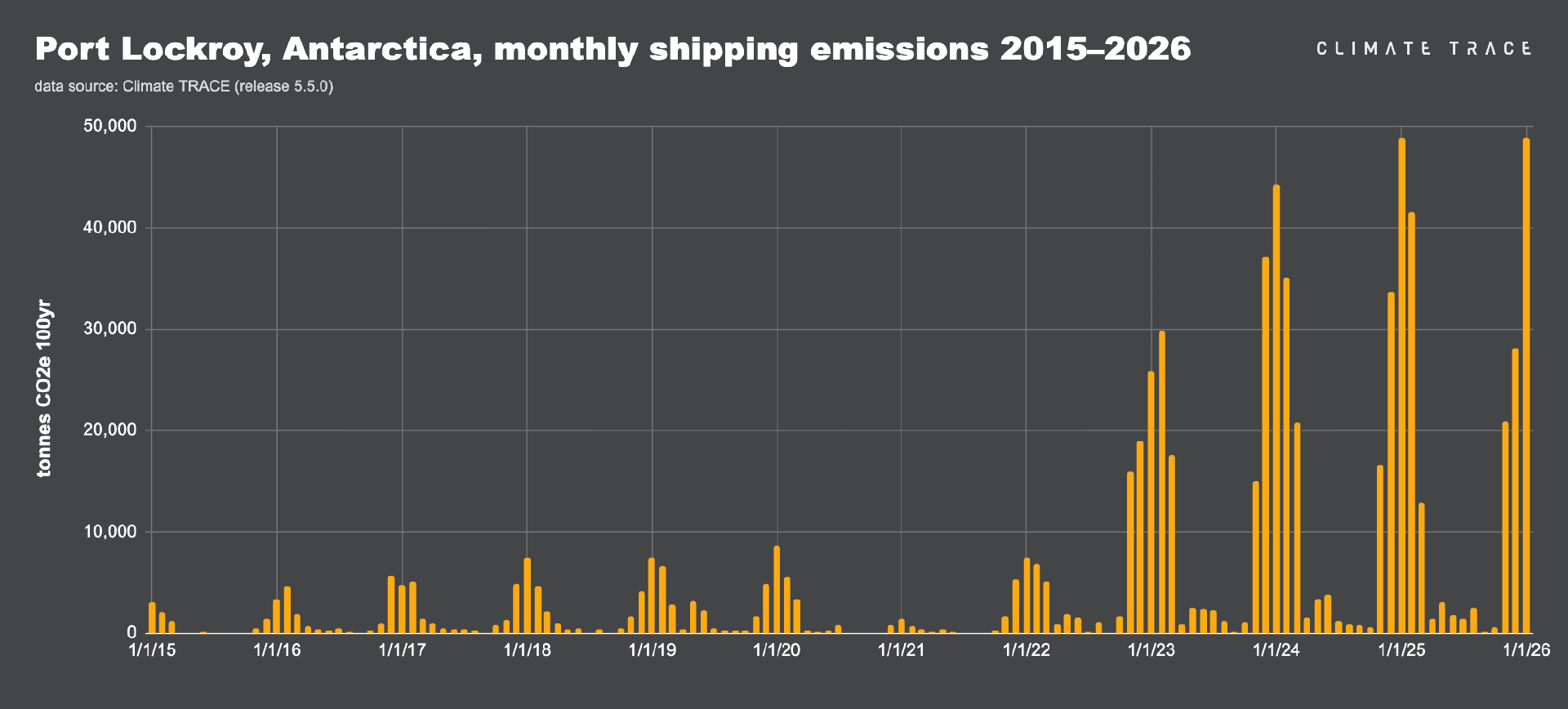
The Climate TRACE data for Port Lockroy tell a story that tightly correlates with the island's annual heartbeat of human activity. Prior to the pandemic, we see a similar trend repeating each year: monthly shipping-related emissions data rise during the summer, typically peak during January (the heart of the summer season), and fall back to nearly zero through shoulder seasons and the Antarctic winter (April to October).
Emissions estimates were little more than a blip during the 2020/2021 season when Port Lockroy stayed shuttered during COVID. Activity and emissions resumed the following year, during Lockroy's partial reopening. Since then, emissions have reached and maintained new heights, in tandem with the surge in Antarctic tourism.
These record-setting emissions numbers for Lockroy aren't big on a global scale. Even so, researchers can use this data to support their work on the environmental impacts of Antarctic tourism activities. Shipping activity and emissions by operator and/or vessel are also available upon request; please contact us for more info.
And also: the western coastline of the Antarctica Peninsula is one of the most rapidly warming places on the planet. Watching what happens in this remote spot can serve as a sort of bellwether for the climate crisis more broadly, even as it's a testament to the granular insights that are possible anywhere via the Climate TRACE database.
Image courtesy UK Antarctic Heritage Trust. Used with permission.