Finnish delight: how the world’s happiest country decarbonized its power sector
In mid-March, the World Happiness Report released the 2026 edition of its eponymous annual assessment. And for the ninth year in a row, one Nordic country in particular topped the list as the world's happiest: Finland.
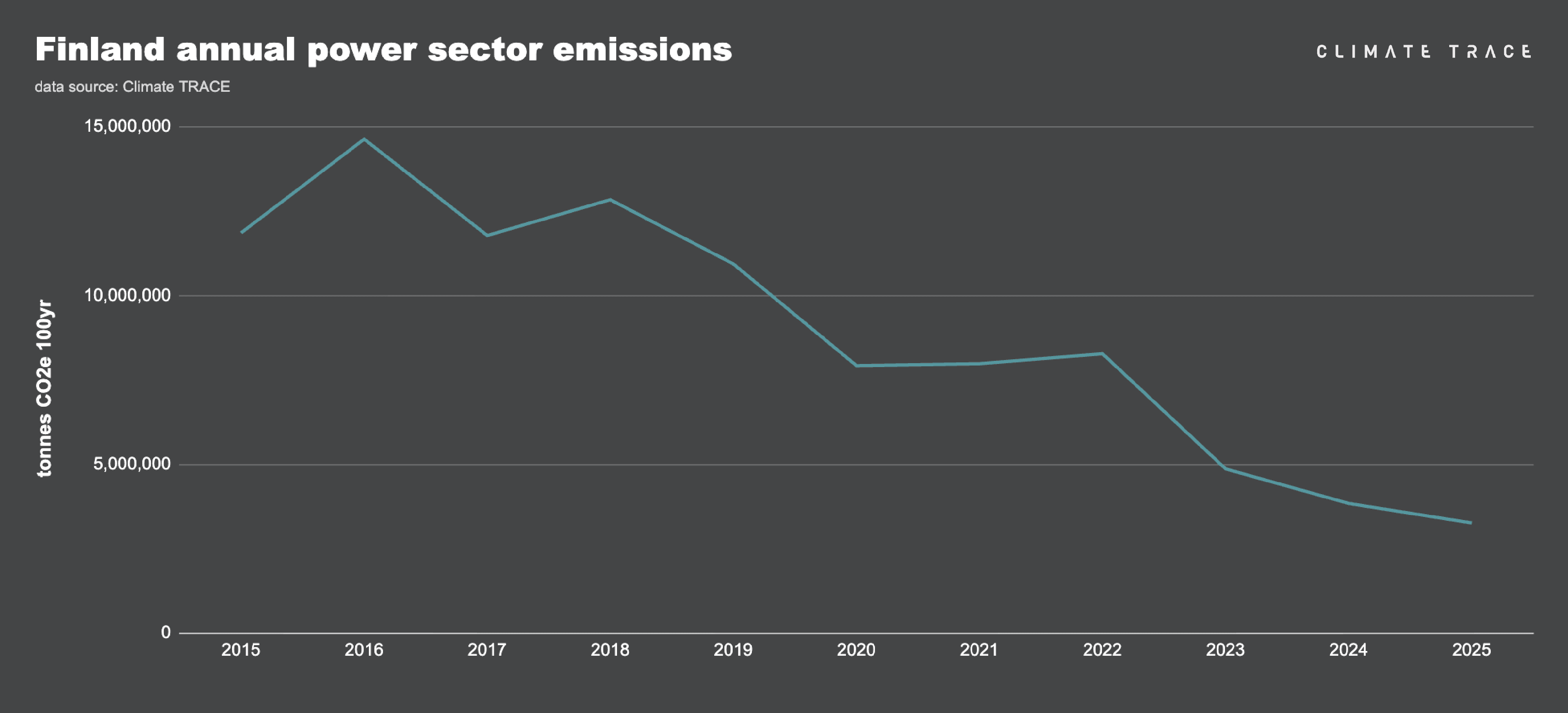
In tandem over the past decade, the country has also accomplished a steep decline in its greenhouse gas (GHG) emissions. While almost every sector of Finland's economy has seen emissions reductions, nowhere has that been more evident than the power sector. Finland already boasted one of the lowest per-capita emissions rates from electricity generation of any European country. But between 2016 and 2025, emissions from electricity generation fell a further almost-80%, from almost 15 million to ~3 million tonnes annually.
According to Climate TRACE data, Finland's power sector saw a larger COVID-related drop in emissions in 2020 vs. 2019, followed by a small rebound in 2021 vs. 2020, but then the country's power sector emissions resumed their decline. This was no accident. Finland's Climate Change Act entered into force in 2022, with major emissions reduction targets for 2030, 2040, and 2050, and a carbon neutrality target by 2035.
Let's take a closer look at how the power sector has evolved for this European nation that shares a 1,300-km border with Russia.
Structural changes to Finland's electricity generation fleet
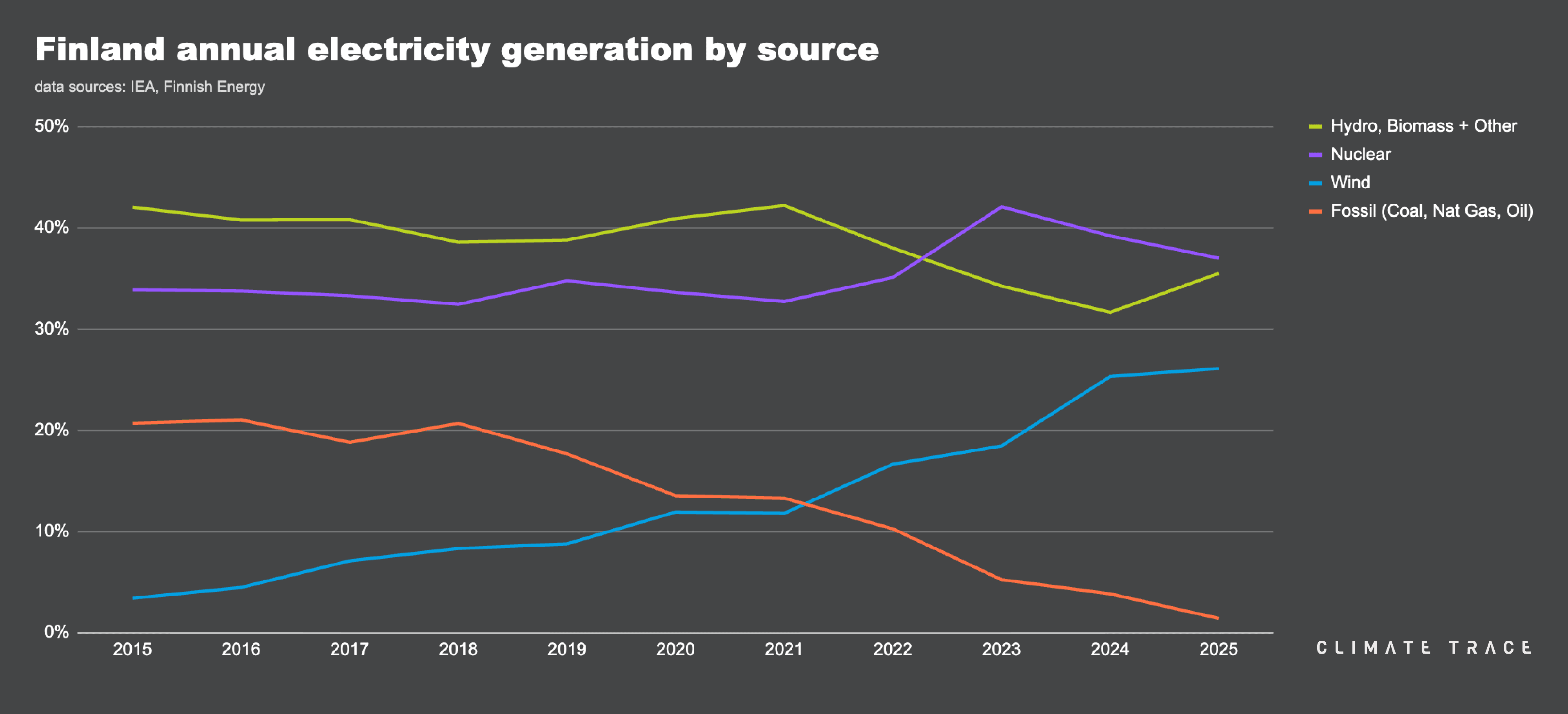
Over the past few years, a confluence of three structural changes in Finland's power sector have helped the nation achieve a nearly 95% carbon-neutral electricity mix:
-
The near-total phaseout of fossil-fueled electricity generation from coal, oil, and natural gas (accounting for less than 4% of generation in 2024),
-
Substantial increases in emissions-free generation from nuclear and wind power (totalling a combined 64.5% of generation in 2024),
-
And the remaining balance coming from a combination of legacy hydropower, biomass or biofuel power plants, and waste-to-energy projects.
How Finland flipped its power supply
In 2022 --- the same year that Finland's Climate Change Act went into effect and years ahead of the EU's December 2025 final plan to phase out all Russian natural gas --- Finland ended 50 years of Russian gas imports as part of a "rapid decoupling," noted Finland's Treasury department.
One year later in 2023, Finland brought online its fifth nuclear reactor, completing the country's current fleet of operating reactors. The new unit helped expand the role of nuclear energy in Finland's grid, with nuclear power now supplying roughly 40% of the country's electricity.
Wind power has also rapidly scaled to fill remaining gaps resulting from the transition away from fossil fuels for electricity generation. Wind capacity in Finland has grown 10x since 2015 and nearly tripled since 2020, pushing its contribution to more than a quarter of the country's electricity mix.
Most recently, Finland's last active coal plant, the Salmisaari power station, permanently shut down in April 2025. The plant's operator is replacing coal with heat pumps, biomass, and waste heat, aiming to achieve carbon neutrality by 2030.
Emissions fall as nuclear and renewables dominate
As Finland's power sector has transitioned almost entirely to clean sources, Climate TRACE data show corresponding emissions reductions, including the aforementioned ~80% decline over the past decade. The post-2022 era following enactment of the country's Climate Change Act shows how important developments in just the past few years have further moved the needle on Finland's power sector emissions.
With the coming online in 2023 of Finland's OL3 --- Europe's largest nuclear reactor --- and the parallel rise in wind generation, Climate TRACE data show especially large declines in both monthly and annual emissions in 2023 vs. 2022.
Then, looking at Climate TRACE asset-level emissions data for the Salmisaari power station --- the last active coal plant in the country --- we see Climate TRACE emissions data stop in March 2025 and no emissions detected in April 2025, coinciding with the power plant's closure in that same month.
Power sector growth alongside economic strength
Like many Nordic countries, Finland has high per-capita electricity consumption due to a combination of colder climate, higher standard of living, and progress in both electrification and EV adoption.
It's perhaps no surprise then that Finland's electricity production has increased by 15.3% from 2021 to 2024, with the country's GDP sitting near an all-time high, per World Bank data, and the country's population growing by 1.6%. Yet in the meantime, power sector emissions fell during that same period, as did electricity consumption per capita (by 6%, per IEA data).
This combination has made Finland a global example for effective decarbonization of a nation's economy. It's an enviable decoupling: a healthy economy with a growing power sector and growing population, paired with declining emissions and falling per-capita electricity consumption (despite ongoing electrification and EV adoption efforts). And amidst all of that, staying abundantly happy while they're doing it.